
Reclaim your AGM! A ten-slide challenge
- Ben Vos

- Jan 27
- 3 min read
Annual General Meetings have a reputation for being dry, dutiful, and sparsely attended. But they don’t have to be. When treated as cultural charging stations rather than procedures to be endured, AGMs become moments of pride, storytelling, and shared purpose. They can remind a community not only of what it must do, but of who it is and where it's headed.
Some formalities are essential: noting changes to Executive and Council portfolios (perhaps extending terms from one to two years), voting on advisory motions, and outlining financial priorities and spending. These must be handled carefully, but they should not usually dominate. An AGM should be more than administration and facts — more than a dutiful hour endured by a handful of stalwarts.
The real content should flow from why people belong in the first place: Torah, Jewish identity, connection, growth. These desires drive our Jewish lives; they should shape our most formal gathering too.
Seen this way, the AGM becomes an opportunity: a moment to say, with confidence, “This is who we are, what we’ve achieved, and where we’re going together.” It becomes storytelling, not slog.
The ten-slide challenge
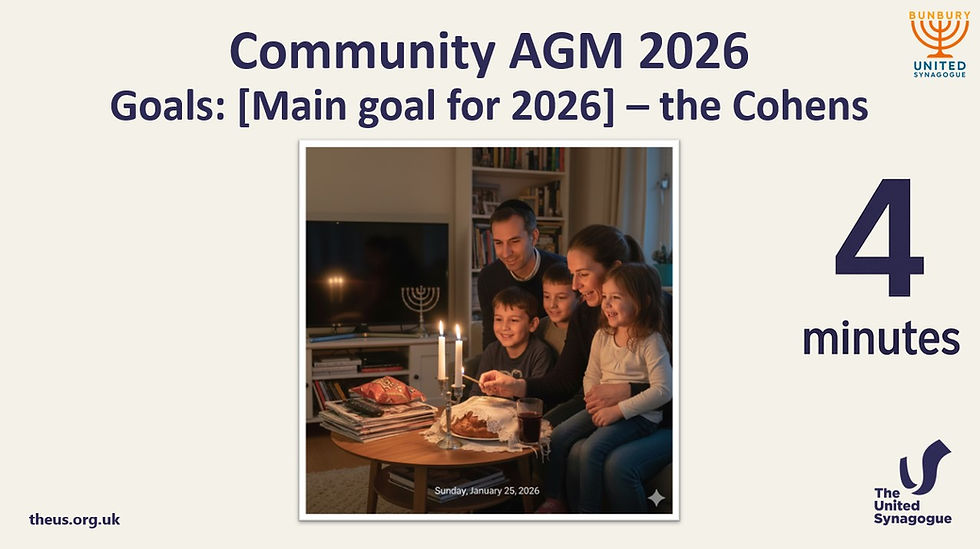
The link below is to a deliberately overlong AGM deck for the fictional Bunbury United Synagogue. Your challenge: cut it to ten slides — or create your own ten‑slide version — that covers the formalities while expressing the heart, soul, and direction of your community.
Please note the comments to the slides, visible by clicking 'Review/Show Comments'. Delete
NB: the link will expire on 26 July 2026 (US policy).


In the meantime...
Whether you take up the challenge or use these slides, or not, please consider the ideas below.
Keeping the slide-count (and the time) down:
Pre‑circulate reports so they don’t need to be read aloud. Make clear that a little homework is expected.
Appoint a 'slide critic' to ask whether each slide helps people understand or feel something. If it doesn't, delete it.
Script your AGM chair's opening and closing lines (not necessarily the same person as the Chair of the community). A crisp start and finish can make a brisk and lively impression on the night and in retrospect.
Replace long introductions with a simple handout of speaker details.
Set a firm break time and end time - and publicise both.
Start on time, even if some people aren’t there.
Group similar items to avoid repetitive discussion.
Brief speakers on time limits and expectations.
Replace reports with narrative. What did we aim to do? How far did we get?
Assign time estimates to each slide.
Use a visible countdown timer to keep everyone honest.
Nominate a tactful but authoritative timekeeper.
Ask for questions in advance to avoid microphone theatrics and rambling answers.
Handle knotty issues through pre-arranged follow-up methods, not on-the-spot debates.
Keep thanks sweet but short, gathered together at the end.
Making your AGM celebratory, not purgatory
Start, break and end with quality refreshments, even supper. Could you bring in a paid-for food-truck instead of the usual rogelach and bridge rolls?
Show, don't tell: a “Top 10 Moments of the Year” can easily create warm fuzzy feelings!
Don't try and cover every strategic priority: it is legitimate (particularly at the AGM in the middle of an Executive's two-year term) to highlight one key area of emphasis, show how it fulfils your Goals and hence your Vision; and have someone describe the impact of your community on them.
If you are creating new lay-leader roles, it is essential for everyone to understand why the roles are needed in terms of community strategy and what the role-holder will do to help fulfil that strategy. Tea and biscuits must be earned!
Consider software such as Slido or Mentimeter for visual variety and to conduct lively 'in-meeting' polls.
Not every incumbent lay-leader needs to report. But if you have a new and/or successful member of the Executive responsible for New Member Integration or an impactful Inclusion Officer on the Synagogue Council, give them the mike to explain their aims, their projects and how others can help.
Use personal stories of impact and change to illustrate goals achieved: data suits some people and has its place here, but everyone understands personal impact.
Close with clarity: recap decisions, next steps, and end on time with a call to action, preferably centred on the Vision of the community.
Reclaim your AGM! As a celebration of identity and direction, we can turn a statutory requirement into a communal heartbeat — one that carries your community, together, into the year ahead.


Comments